
Hockey plus/minus explained: beyond goals and assists
Plus/minus credits defensive work that never reaches the scoresheet. Here is which goals count, and how to follow it for a whole team.
On this page
- Positive
- +2
- Even
- E
- Negative
- -1
- Not tracked
- —
Not every good game ends with a goal or an assist. A defensive defenseman can spend a night shutting down the other team's best line and finish with nothing on the scoresheet. A defensive-minded center can win the key draws and cover for a pinching winger. Plus/minus is one of the few numbers most teams can keep that reflects what those players add.
What plus/minus measures
Plus/minus is the qualifying goals your team scored minus the qualifying goals your team allowed while a skater is on the ice. It is written +/-. It records what happened on the ice with that player out there. It does not record who caused a goal, so it never says whose mistake or whose save changed the score.
Which goals count
A goal counts when it is scored at even strength or short-handed. A power-play goal counts for nobody. Each row is read from the scoring team's side.
| Goal scored | Counts? | Effect on skaters on the ice |
|---|---|---|
| Even strength | Yes | Plus for the scoring team, minus for the other team |
| Power play | No | Nobody gets a plus or a minus |
| Short-handed | Yes | Plus for the short-handed team, minus for the team on the power play |
| Empty net | Yes, unless scored on a power play | Counts like any other goal of the same strength |
| Penalty shot | No | Nobody gets a plus or a minus |
| Shootout | No | Nobody gets a plus or a minus |
A few cases trip people up. A goal against while your team is killing a penalty is not a minus, and a goal for while killing a penalty is a plus. If the other team scores short-handed while your team is on its own power play, the skaters on the ice for your team get a minus, even though your team had the advantage.
An empty-net goal counts unless it is scored on a power play. Pulling the goalie does not create a power play. Penalty-shot and shootout goals never count. Goalies do not get a plus/minus.
A worked example
Say these goals went in while a skater was on the ice:
- 3 even-strength goals for the skater's team
- 1 short-handed goal for the skater's team
- 2 even-strength goals against
- 1 power-play goal against
Count the pluses first: 3 + 1 = 4. Then the minuses: the two even-strength goals against count, but the power-play goal against does not, so that is 2. The game's plus/minus is 4 - 2 = +2.
How plus/minus is shown
A positive number gets a plus sign, like +2. A negative number shows with a minus sign, like -1. Zero is shown as the letter E, for even. A dash means the stat was not tracked, which is different from an even game. The hockey stat abbreviations guide lists every other label you will see beside it.

Track plus/minus for your whole team, game by game.
Plus/minus is a per-game option: pick who was on the ice for each goal that counts, and the app credits each skater when you submit the game.


Why defensive players deserve a closer look
Goals and assists favor the players who finish plays. The work that prevents a goal, such as closing a gap or backchecking hard, rarely shows up as a number, and plus/minus does not record those plays either. What it gives you is a lens over a run of games: when a defensive player is on the ice, does the team tend to come out ahead or behind? For a stay-at-home defenseman or a center who takes the tough defensive draws, it is often the only routinely kept number that moves when they do their job well. It does not prove defensive ability, but it is a fair place to start.
Who it helps
Families see contribution beyond points.
Coaches can read the totals alongside the line and pair context they know from the bench.
Clubs can agree on one set of recording rules.
Context, not the whole evaluation
Plus/minus is a team result with an individual name on it. A skater gets a plus when a teammate scores, even if they were nowhere near the play. Team strength, teammates, goaltending, the opposition, ice time, sample size and empty nets all move the number.
Use it as a conversation starter, not a grade. To read it fairly:
- Compare a player to teammates on the same team, not to players on other teams.
- Watch the trend across a month of games instead of reacting to one night.
- Pair it with something the player controls, like faceoffs. The faceoff percentage guide is a good next read for centers.
Why tracking a whole team by hand is hard
Someone has to know who was on the ice at every goal, work out whether it came at even strength or on a power play, and credit the right skaters, game after game. One missed change throws off a whole tally.
How IceStats Pro helps
In IceStats Pro, plus/minus is a per-game option. When it is turned on, the person tracking the game picks from the game's lineup who was on the ice for each goal that can count. On power-play, penalty-shot and shootout goals it skips that step, since those goals don't count. Once the game is submitted, IceStats Pro adds the plus or minus to each skater picked, automatically. Goalies never accumulate plus/minus.
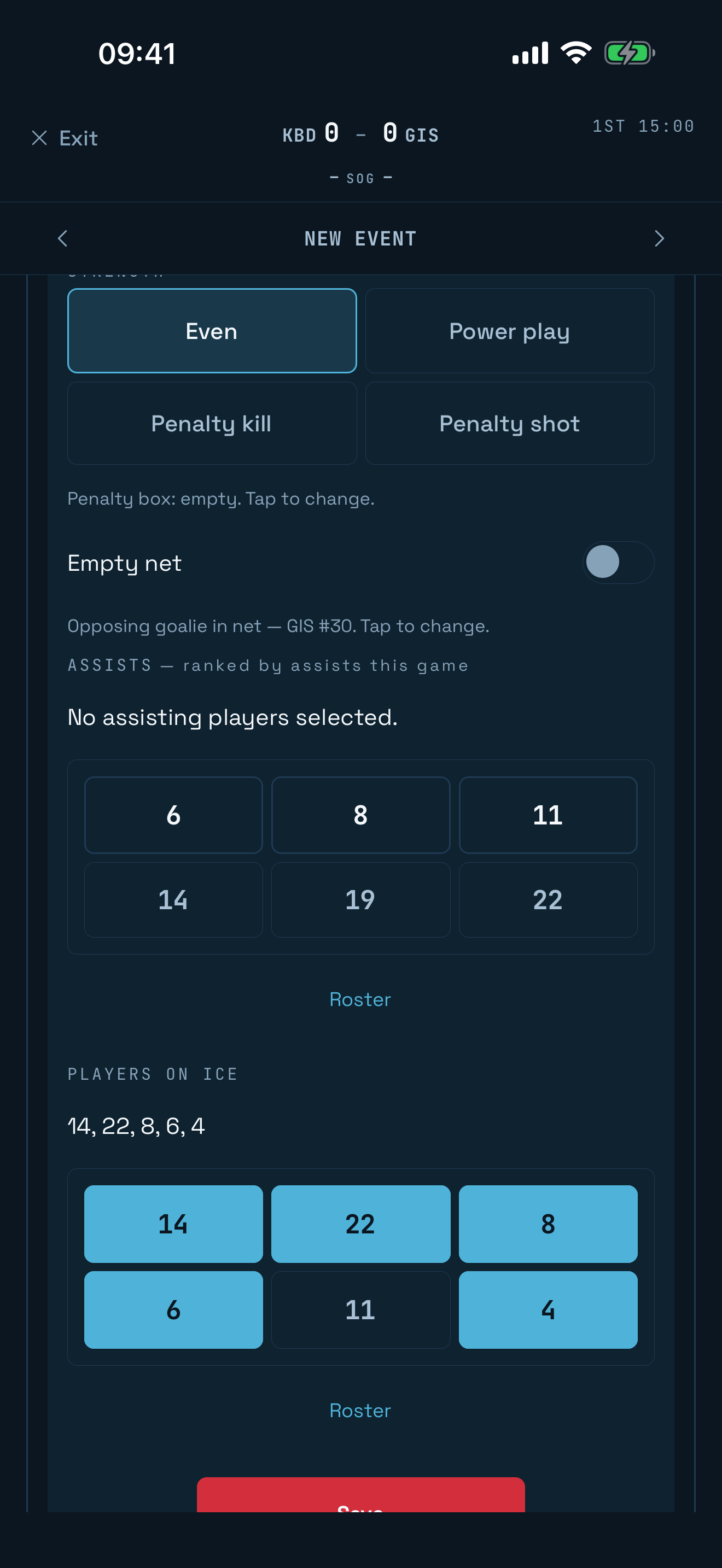
When special-teams tracking is on for a game, the penalties recorded in that game decide each goal's strength. With special teams off, the strength chosen by the person tracking the game is what counts. Pulling a goalie is not a penalty, so it never creates a power play. When plus/minus is off for a game, the stat shows as not tracked, a dash, rather than as zero.
Ending a game and submitting it for a report produces that report and a stats site you can share. See how game tracking becomes a shareable stats site. For the other stats worth keeping, see the guide to tracking youth hockey stats, or browse the live demo stats site, which uses made-up players, to see plus/minus in a real table.
Ready to track your team's next game?
Apple, the Apple logo, iPhone and iPad are trademarks of Apple Inc., registered in the U.S. and other countries and regions. App Store is a service mark of Apple Inc. Google Play and the Google Play logo are trademarks of Google LLC.